Britain's forgotten pre-radar listening devices and the remarkable story behind them.

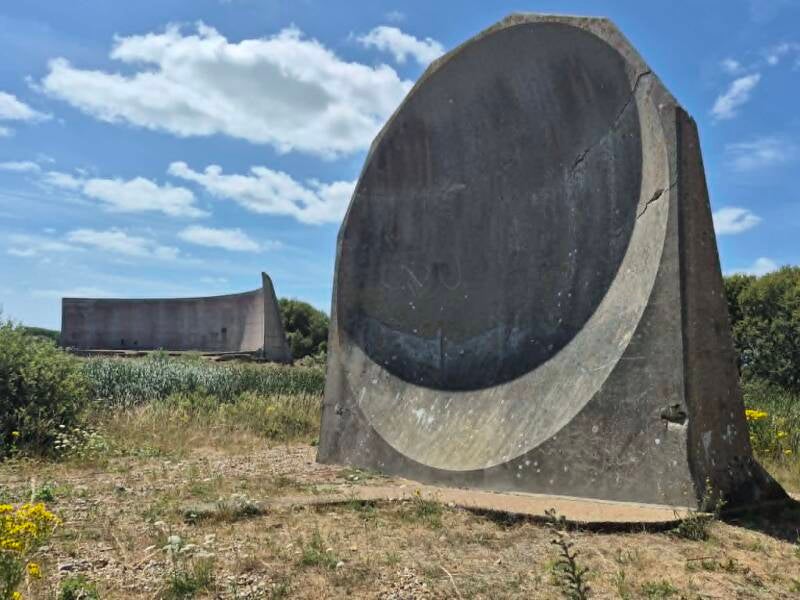
The Romney Marsh Sound Mirrors at Denge. The 30-foot acoustic mirror dominates the foreground, with the 20-foot mirror beyond and part of the impressive 200-foot sound wall visible in the distance. Image Credit: Author's image.
There was nothing to see at first.
Darryl and I had parked a short distance from the site and knew the Sound Mirrors had to be somewhere ahead of us. Even so, the landscape refused to give them away. We asked another group of walkers if we were heading in the right direction and they pointed towards a distant line of trees. Looking a little more carefully, I could just make out the top of one of the great concrete mirrors rising above the foliage.
It was only a small glimpse, but after years of wanting to visit Britain's forgotten listening ears, it was enough to make me eager to get closer.
The Sound Mirrors of Romney Marsh have fascinated me for a long time. They belong to a brief but remarkable period when Britain was searching for an effective way of detecting hostile aircraft before radar transformed air defence. Thanks to one of the RSPB's occasional guided open days, Darryl and I were finally able to explore a site that is normally closed to visitors.
Crossing onto the Marsh
The reserve itself was every bit as interesting as I had imagined.
Large expanses of water stretched across the marsh, while modern development remained largely confined to its edges. The mirrors now stand on what feels like a small island connected by a bridge. Because the site lies within the RSPB's Dungeness Nature Reserve, public access is carefully controlled for most of the year to protect the wildlife. That makes the opportunity to walk among the structures all the more special.
Before the talk began, visitors were encouraged to wander freely around the site, take photographs and simply enjoy being there.
Standing beside the mirrors quickly changes your perspective. I had seen countless photographs over the years, yet none of them prepared me for their true scale. They are far larger than I had imagined. Time has weathered the concrete into varying shades of grey, but they remain remarkably complete.
Looking later at archive photographs, I was equally surprised by how much the surrounding landscape has changed. The shingle banks were once higher, there were fewer buildings along the coastline, and the mirrors looked out across a far more open landscape than they do today.
Britain Learns to Listen
After everyone had explored the site, we gathered to hear one of the RSPB guides explain the remarkable story behind these strange concrete structures.
The origins of Britain's acoustic experiments can be traced back to the Zeppelin raids of 1915 and 1916, when Britain first began searching for a way of detecting approaching aircraft before they came into view. Kent, lying closest to continental Europe, was the natural place to begin such experiments.
During the years that followed the First World War, those early ideas developed into a serious programme of research under the direction of Major William Sansome Tucker of the Royal Engineers. Working from the Acoustic Research Station at Hythe from around 1922, Tucker became one of the leading pioneers of acoustic detection and devoted much of the following decade to refining the concept.
Long before radar became a practical reality, Tucker and his colleagues believed that sound might provide Britain with the precious few minutes of warning needed to prepare for an air attack.
The solution was both simple and ingenious.
Large curved concrete reflectors concentrated the sound of approaching aircraft onto sensitive listening equipment positioned at a focal point. Operators sitting behind the mirrors listened carefully through acoustic devices, attempting to determine the direction of approaching aircraft while they were still beyond visual range.
The experiments carried out on Romney Marsh formed one of the most ambitious chapters in that search.
The 20-foot Sound Mirror, completed in 1928, was the first of the three experimental concrete mirrors built at Denge. Its success helped demonstrate the potential of acoustic detection and paved the way for the larger designs that followed, including the vast 200-foot sound wall visible in the background. Image Credit: Author's image.
Three Mirrors, Three Experiments
One aspect of the site that particularly impressed me was that it tells the whole story of the technology's development.
Although usually referred to as the Romney Marsh Sound Mirrors, this remarkable complex actually stands at Denge, near Greatstone, and is unique in preserving the complete evolution of Britain's acoustic experiments.
Rather than finding three identical structures, visitors see three very different designs. Each represents another step in the development of acoustic detection.
The first, a 20-foot mirror completed in 1928, demonstrated that the principle could work. Encouraged by the results, a larger 30-foot mirror was constructed between 1929 and 1930, refining the original design in the hope of increasing its effectiveness. The final stage was the enormous 200-foot curved sound wall, completed in 1930 and actively tested over the following few years. Standing beneath it, it is difficult not to be impressed by both its scale and the ambition of the engineers who designed it.
These structures were not Tucker's first experiments. Earlier trials had included acoustic mirrors cut into the chalk cliffs near Dover after the First World War, together with smaller concrete mirrors at Hythe, before work eventually moved to Denge where the concept reached its most ambitious form.
Walking between them, it becomes obvious that this was never a single invention. It was a process of continual experimentation as Tucker and his team searched for better ways of hearing approaching aircraft before they could be seen.
Although Denge contains the finest collection of Sound Mirrors in Britain, it is not alone. Other surviving examples can still be found at Hythe in Kent, Fulwell near Sunderland and Kilnsea on the East Yorkshire coast. Together they represent the surviving evidence of Britain's first serious attempts to establish an effective early warning system against attack from the air.
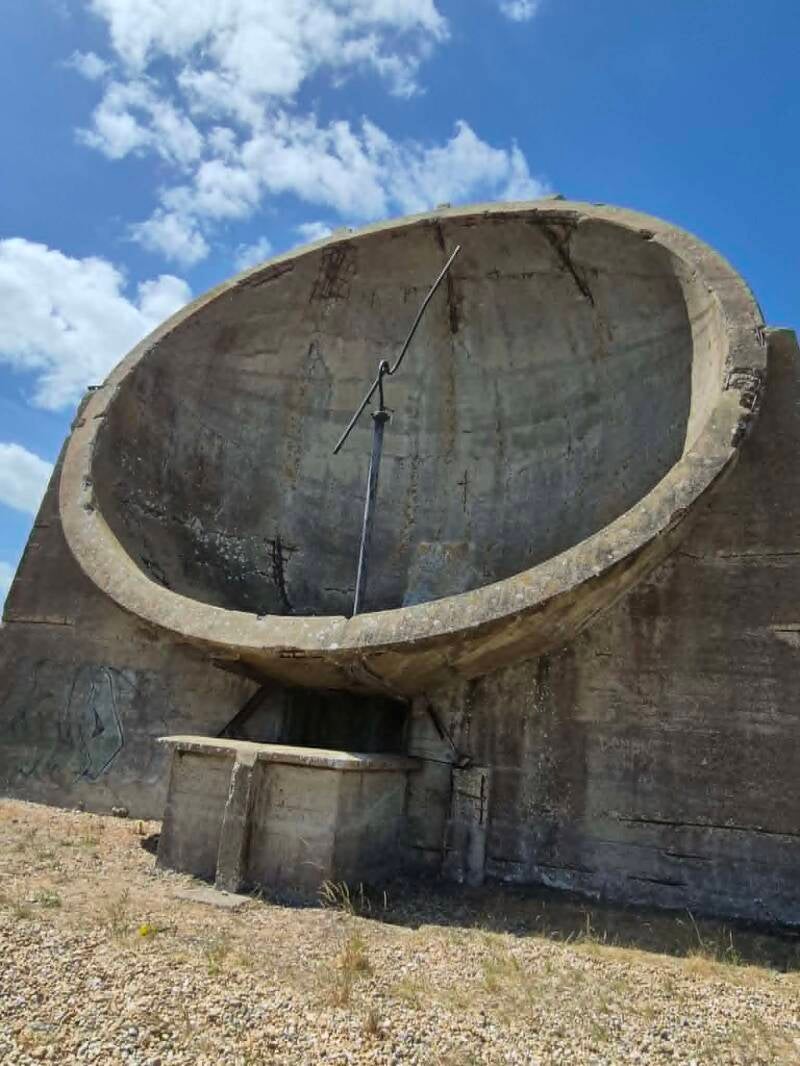
The 30-foot Sound Mirror, completed between 1929 and 1930, represented the next stage in Britain's acoustic detection experiments. Even photographs struggle to convey its true scale, something that only becomes apparent when standing beneath the immense concrete structure. Image Credit: Author's image.
When Sound Was No Longer Enough
One point made during the talk stayed with me because it challenged something I had always believed.
Like many people, I had assumed the Sound Mirrors simply became obsolete the moment radar appeared. The reality is rather more interesting.
When the earliest mirrors were conceived, aircraft were comparatively slow. During the First World War many flew at little more than one hundred miles an hour. By the end of the 1930s, aircraft capable of travelling at more than three hundred miles an hour were becoming increasingly common.
The problem was that sound does not become any faster.
As aircraft speeds increased, the amount of warning the mirrors could provide steadily diminished. By the time the sound had reached the mirror, been interpreted by the operators and the warning passed on, an approaching aircraft had already travelled a considerable distance.
The decisive turning point came in February 1935, when Robert Watson-Watt's famous Daventry Experiment demonstrated the enormous potential of radar. Within only a few years, Britain was constructing the Chain Home radar network around its coastline, and the Sound Mirrors quietly passed into history. Their pioneering work had not been wasted. Instead, it had formed an important stepping stone in Britain's continuing search for an effective early warning system.
It was one of those explanations that immediately made perfect sense. Until that afternoon, I had simply assumed radar had swept the mirrors aside overnight. In reality, the rapid pace of aviation had already begun to expose the limitations of acoustic detection. The mirrors had not failed. They had simply been overtaken by the extraordinary speed of technological progress during the years between the two world wars.
The Human Story
The visit also made me think about the people behind this forgotten chapter of military history.
Operating a Sound Mirror was hardly a glamorous role. It demanded patience, concentration and long periods of careful listening. Personnel often spent hours behind the mirrors attempting to distinguish the distant sound of aircraft engines from the many natural sounds carried across the marsh.
They may never have enjoyed the recognition given to fighter pilots or radar operators, yet they played an important part in Britain's determination to improve its defences during the difficult years between the two world wars.
One fascinating point raised during the talk was that acoustic technology never disappeared entirely. Although these great concrete mirrors became obsolete, the military has continued to develop sophisticated acoustic systems for specialist purposes, including locating the source of gunfire and sniper fire on the modern battlefield.
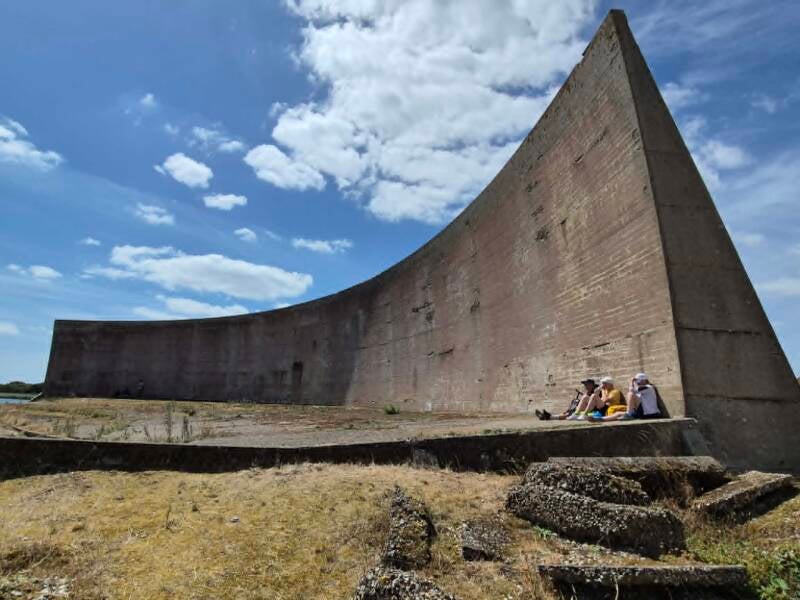
The immense 200-foot curved Sound Wall, completed in 1930, marked the final and most ambitious stage of Britain's acoustic detection experiments. Designed to gather the sound of approaching aircraft across a much wider area, it remains one of the most remarkable surviving monuments to Britain's pre-radar air defence programme. Image Credit: Author's image.
A Forgotten Chapter
Perhaps the greatest surprise was how well the mirrors have survived.
Unlike much of Britain's later radar infrastructure, these enormous concrete structures were never easily removed. The Chain Home radar stations that succeeded them relied largely on steel towers, aerials, wooden buildings and electronic equipment. As technology advanced after the Second World War, many of those installations were dismantled, replaced or simply disappeared from the landscape.
The Sound Mirrors were different. Built from reinforced concrete on a monumental scale, they were simply left where they stood. Today they survive as rare reminders of an experimental chapter in Britain's military history, bridging the gap between the visual observation posts of the First World War and the radar network that would later prove so vital during the Battle of Britain.
After the talk had finished, visitors were once again free to wander around the site. I found myself looking at the mirrors rather differently. They were no longer just unusual concrete structures sitting quietly on the marsh. Instead, they represented an important stage in Britain's determination to defend its coastline at a time when military aviation was advancing at an astonishing pace.
As Darryl and I crossed the bridge and made our way back towards the car, I looked back one final time. It struck me that the Sound Mirrors occupy an important place in the story of Britain's air defences. They were neither a failure nor a historical curiosity. They were an essential stepping stone between visual observation and radar, and one of the few physical reminders of that remarkable period still standing today.
For anyone with an interest in military history, aviation or Britain's hidden heritage, the Sound Mirrors are well worth visiting. Although they can be seen from nearby public footpaths throughout the year, the organised open days offer a rare opportunity to walk among all three structures and fully appreciate both their scale and their significance.
Acknowledgements
My thanks to the staff and volunteers at the RSPB Dungeness Nature Reserve for organising the guided visit and for sharing the fascinating history of the Sound Mirrors.
Further Reading
RSPB Dungeness Nature Reserve
Historic England: Sound Mirrors at Greatstone
Romney Marsh History: The Sound Mirrors
Richard Newton Scarth, Echoes from the Sky: A Story of Acoustic Defence
Richard Clements
The History Alchemist
Richard Clements is a writer and independent researcher behind The History Alchemist, exploring Britain's overlooked history through original research, field investigations and visits to historic sites. His work focuses on the people, places and stories that have quietly shaped our past but are often forgotten today.
More articles and investigations can be found at www.thehistoryalchemist.com.
Add comment
Comments
Are these related to the sound mirror at the Cliffs of Dover? Or was that one listening for boats when the fog might hide them from visual detection?
Thanks for your comment. Yes, they're very much related. The Dover Sound Mirror was one of the earlier acoustic experiments that helped pave the way for the larger mirrors later built at Romney Marsh. Although it's easy to assume they were intended to detect ships hidden by fog, their primary purpose was actually to listen for the sound of approaching aircraft engines long before the aircraft themselves came into view. It's a fascinating chapter in the story of Britain's early air defence, and one that's often overlooked. Thanks again for taking the time to read the article and leave a comment.