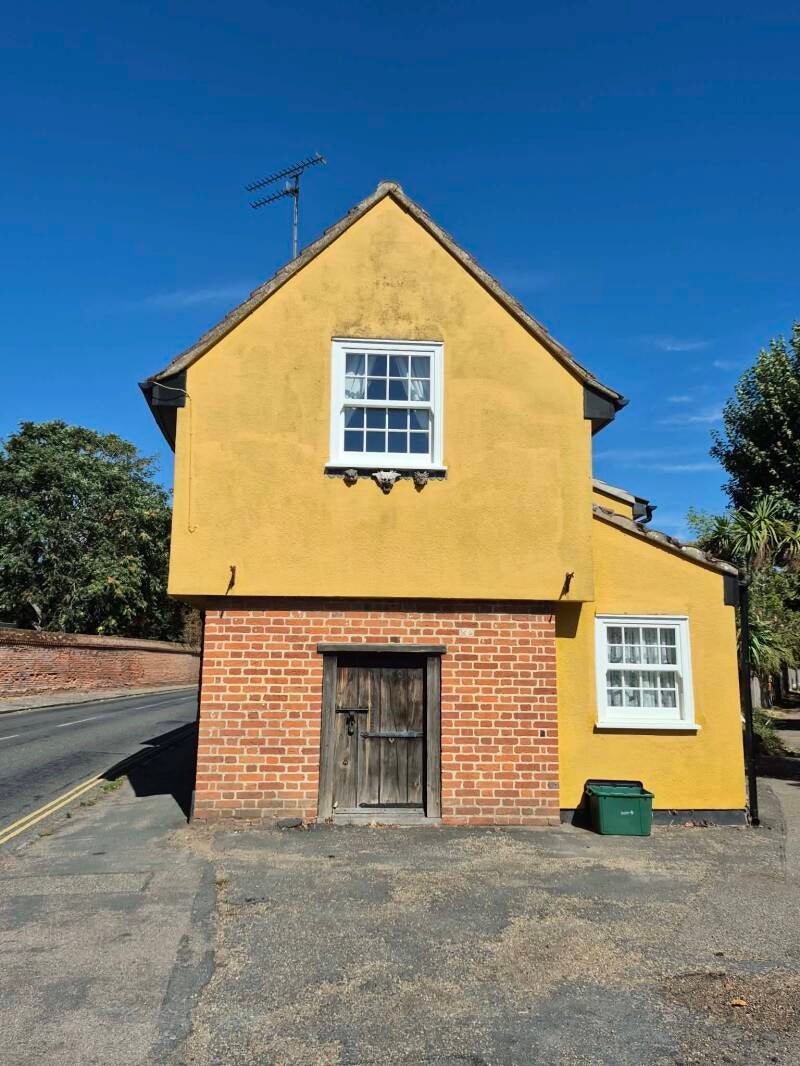
The Cage at St Osyth, Essex.
Photograph: Richard Clements / The History Alchemist
The Cage at St Osyth is said to have held an accused witch, confined generations of local offenders and later driven its owner from her home. Behind the familiar story, however, lies a more complicated question. What exactly is the Cage, and how did it become one of Britain’s best-known haunted houses?
Stand outside the Cage in St Osyth and it is easy to see why people stop to look.
The building stands beside Colchester Road, directly opposite the long wall surrounding St Osyth Priory. Its yellow exterior makes it difficult to miss, but the feature that draws the eye is the heavy wooden door set into the older-looking brickwork at ground level. It resembles the entrance to a cell, and that is precisely what generations of visitors have believed it to be.
A plaque fixed to the building identifies it as the village lock-up. It also connects the place with Ursula Kemp, one of the women caught up in the St Osyth witch trials of 1582.
In more recent years, the Cage has become better known for something else. It has been described as one of Britain’s most haunted houses, opened to paranormal investigators and featured in books, newspapers and television programmes. Reports of apparitions, moving objects and physical attacks have become part of its modern identity.
The familiar version of the story appears to fit together remarkably well. An accused witch is imprisoned in a village cell and executed. Centuries later, strange things are reported inside the building. The old lock-up becomes a haunted house.
It is a powerful story.
The difficulty is that parts of it may belong to different buildings.
The women behind the story
The events that brought Ursula Kemp’s name into the history of St Osyth began in 1582.
Ursula was a local woman who appears to have earned money through nursing, healing and other services provided within the community. Such knowledge could make a woman valued by her neighbours, but it could also leave her dangerously exposed when illness or misfortune followed an argument.
One of the principal accusations came from Grace Thurlow, whose child had become ill. A disagreement over Ursula’s services appears to have contributed to the suspicion that followed. What might once have remained a quarrel between neighbours was drawn into a wider investigation overseen by the local magistrate Brian Darcy.
Ursula was questioned at St Clere’s Hall, Darcy’s residence near St Osyth. Her young son, Thomas Rabbet, was also called upon to give evidence against her. He described animals supposedly kept by his mother as familiars, including cats, a toad and a lamb.
These stories sound strange to modern ears, but they were taken seriously within the legal and religious world of Elizabethan England. Ursula eventually confessed, apparently after being led to believe that cooperation might bring mercy. Her confession implicated other women and helped the accusations spread beyond St Osyth into neighbouring Essex communities.
The surviving account was published in 1582 as A True and Just Recorde. It is an invaluable source, but it is not a neutral transcript. The pamphlet presented the investigation as a successful exposure of witchcraft and shaped its subjects accordingly.
At least two of the accused, Ursula Kemp and Elizabeth Bennet, were executed. Four more are thought to have died in prison, while others remained confined for years. One woman was not released until 1588. The “St Osyth witches” were therefore not simply characters in an isolated village legend. They were real people caught in a much wider outbreak of fear and accusation across north-east Essex.
There is no surviving record telling us that Ursula was held inside the building now known as the Cage.
St Osyth Museum acknowledges the tradition but states plainly that it knows of no evidence supporting it. What can be documented is that Ursula was questioned at St Clere’s Hall before being committed for trial.
It is certainly possible that a local lock-up was used during the early stages of the investigation. A secure place may have been required while the prisoners waited for further questioning. It is also possible that they were held in an outbuilding at St Clere’s Hall, somewhere within the former priory estate, or in another building controlled by Darcy.
Possibility, however, is not the same as evidence.
The prison at Colchester
Once Darcy’s examinations were completed, the women entered a much larger system of imprisonment and trial. They were taken to Colchester Castle, which was then being used as the county gaol, and held there before appearing at the Chelmsford Assizes.
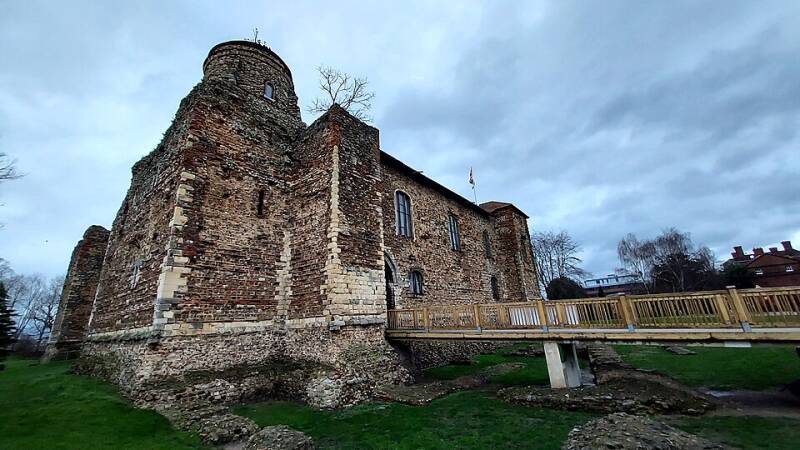
Colchester Castle, where Ursula Kemp and other accused women were imprisoned before trial.
Photograph: Wikimedia Commons, Public Domain
This part of the story has received far less attention than the Cage, yet the connection with Colchester is much firmer. There is even an account of a local man travelling to Colchester Castle to consult Ursula while she was imprisoned there. Despite the accusations against her, people apparently continued to seek the help for which she had previously been known.
Colchester Castle had a long association with imprisonment. Its Norman keep was no longer serving its original military purpose and parts of it were used to confine prisoners. Accused witches were held within its walls during the sixteenth century, and it would perform the same grim function during the Matthew Hopkins prosecutions of the 1640s.
More than sixty years after the St Osyth trials, women accused during the Hopkins witch hunt were crowded into the Castle while awaiting trial. Some died during their imprisonment. The cells now associated with Matthew Hopkins therefore belonged to a much longer history of confinement and persecution.
This raises an awkward question. If Ursula Kemp and the others are known to have been held at Colchester Castle, why has the smaller and less certain connection with the Cage come to dominate their story?
Part of the answer may be visual. Colchester Castle has carried many different histories, from the Romans and Normans to the Civil War and the development of the modern museum. The Cage is smaller and more personal. It stands within the village where the accusations began and can be attached almost entirely to one story.
The claim that Ursula occupied a tiny cell in St Osyth creates an immediate link between a surviving building and a named woman. Colchester Castle, although better documented as a place of imprisonment, does not provide quite the same intimacy.
We still do not know where Ursula and the other women spent the nights between Darcy’s examinations. They may have been placed in the village lock-up. They may have remained somewhere on the Darcy estate. What cannot presently be demonstrated is that they occupied the particular structure now known as the Cage.
In some ways, the attention given to the yellow building has obscured the place where Ursula’s imprisonment can be followed with greater confidence. The Cage has become the visual symbol of her confinement, while the Castle at Colchester has slipped from the popular version.
Which Cage?
Village lock-ups were once a familiar part of the English landscape. Usually consisting of a single secure room, they were intended for short periods of detention rather than long imprisonment. Drunks, vagrants and people awaiting the arrival of a magistrate or transport to a larger gaol might spend a night inside one.
Many were known locally as cages, blind houses or round houses.
St Osyth certainly possessed a building called the Cage. The 1841 census recorded several people confined there on the night of 6 June, including prisoners as young as fifteen. This shows that a local place of confinement remained in use during the nineteenth century, but it does not automatically prove that the surviving building was that lock-up, still less that the same structure existed in 1582.
That distinction has become increasingly important.
Recent research published by Paranormal Reason examined historic maps, estate records and photographs of Colchester Road. Particular attention was given to an estate plan based on a survey made in 1814 and published in 1816. The plan appears to show a small isolated structure standing in what is now the roadway, close to the present property but separate from it.
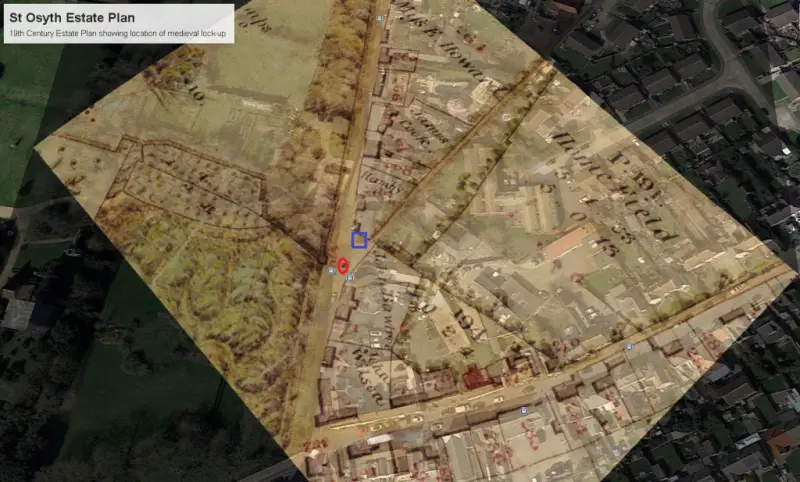
The nineteenth-century St Osyth estate plan overlaid on the modern landscape, showing the proposed location of the former village lock-up in relation to the present Cage.
Image: Paranormal Reason, reproduced with permission.
The researchers initially placed this lost structure a short distance south of No. 14. Further work, using an early twentieth-century postcard and fixed points within the surrounding landscape, refined the proposed position. Their latest interpretation places the former lock-up in the road immediately beside the present building.
This is not a minor alteration to the accepted story.
The same research argues that No. 14 Colchester Road and its small end annexe were built during the nineteenth century. An early postcard appears to show that the annexe shared the construction and symmetry of a neighbouring property, suggesting that it began as a domestic service building rather than a surviving medieval cell.
By the later twentieth century, this single-storey section had been reconstructed and incorporated into the house. An upper floor was added, helping to create the building seen today.
The research also questions the claim that the lock-up remained in use until 1908. The postcard, probably dating from around 1902 to 1904, shows the present properties but no separate building in the road where the earlier estate plan appears to place the Cage.
This does not settle every question. Historical maps have limitations, buildings are altered and local names can move from one site to another. St Osyth Museum continues to describe the present Cage as a former village lock-up, while the present owners accept the traditional identification and have assembled their own historical case for it.
What the newer research does establish is that the connection cannot simply be treated as beyond question.
The most intriguing possibility is that the old lock-up and the present Cage stood almost side by side. If the earlier structure disappeared, its name and history may gradually have attached themselves to the neighbouring building. A plaque, local memory and repeated retellings could then have completed the process.
Places do not need to be physically ancient to inherit an old story.
Returning to the Cage
I had visited St Osyth and seen the Cage before, but this was my first return since the property entered its latest period of ownership.
The first thing that struck me was how instantly recognisable it remains. The Cage is not a large building, nor does it dominate its surroundings. Even so, there is no mistaking it.
Everything appears to sit in the right proportions. The section identified as the old lock-up looks much like an end gable attached to an existing property. Whatever its true date and original purpose, the different parts have been joined together remarkably well. It does not look like a crude modern attempt to manufacture an old building.
There have been visible changes since my earlier visit. The windows have been replaced, but the new owners appear to have chosen sash-style fittings appropriate to the older appearance of the property. The heavy wooden door also remains. On the day of our visit it was secured with a large bolt and padlock, suggesting that more attention has been given to securing the building while work continues.
The owners were not present and Darryl and I remained outside, taking photographs from the public road. This was not a paranormal investigation or a visit intended to test any of the claims. It was simply an opportunity to look closely at the exterior and consider how the building sits within the surrounding landscape.
That setting matters.
The Cage stands extremely close to Colchester Road. Beside it runs a narrow route traditionally known as Coffin Alley, supposedly used when bodies were carried towards a burial place. Whether that explanation can be documented is another matter, but the name has become part of the folklore surrounding the property.
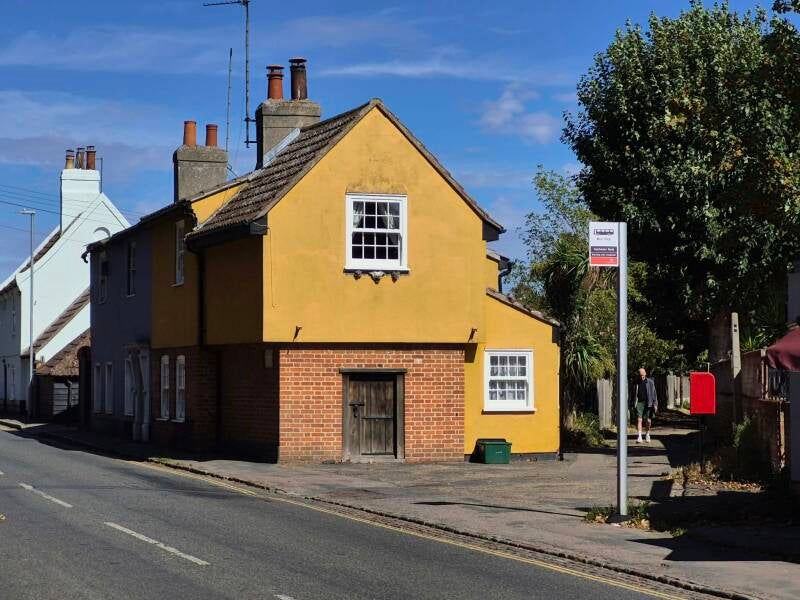
The Cage in its wider setting on Colchester Road, with Coffin Alley running alongside the property.
Photograph: Richard Clements / The History Alchemist
Standing there also made the alternative-location research easier to picture. If the earlier lock-up occupied part of the roadway immediately beside the present house, the two sites were separated by very little. It is not difficult to imagine the name and history of a demolished structure becoming attached to its surviving neighbour.
While we were taking photographs, a couple stopped to speak to us. They were keen to show us a new plaque that the present owners had placed on the side of the building. We were grateful for their interest and spent some time talking with them about the Cage and the attention it continues to receive.
A second conversation offered a different perspective.
A local gentleman told us that, many years ago, he had gone out with a young woman who lived in the Cage. He had spent many nights inside the property and knew it as a home rather than an investigation venue. Despite that experience, he remained decidedly sceptical about its haunted reputation.
His recollection does not disprove anything reported by later occupants. Neither should it be dismissed because it does not fit the more dramatic version. People can spend years inside a supposedly haunted building without experiencing anything unusual, while another person may be deeply affected after only a short visit.
What his story does provide is a reminder of the Cage before it became famous. For him, it was a place associated with a young woman he once knew and the evenings he spent visiting her. It was not yet Britain’s most haunted house.
That identity came later.
Vanessa Mitchell and the haunted house
Whatever the origins of the building, its modern reputation developed during the early years of the twenty-first century.
Vanessa Mitchell bought the property in 2004. According to her later accounts, she did not initially understand the full extent of its local reputation. Soon after moving in, she began to experience things she could not explain.
The early incidents were relatively ordinary by the standards of a haunting narrative. Doors reportedly opened, latches moved, taps turned on and objects shifted without an obvious cause. Mitchell later described the activity as becoming more threatening. She reported sudden cold, dark figures, unexplained marks and occasions when she believed she had been physically touched or pushed.
The experiences were particularly troubling while she was pregnant and after the birth of her son. After living there for roughly three to four years, she left the property.
These are personal claims and cannot now be independently tested. It would be equally unfair either to present them as established fact or to dismiss the fear described by the person who lived through them.
The house did not fade quietly back into village life after Mitchell moved out. Instead, it entered a new period.
Paranormal investigators were allowed inside and organised events gave members of the public an opportunity to spend time in the building. Visitors reported voices, footsteps, moving doors, unusual smells and sudden changes in atmosphere. One much-discussed piece of CCTV footage appeared to show the face of an investigator changing into an unnaturally wide grin.
As the investigations continued, the story travelled.
Mitchell and paranormal researcher Richard Estep published Spirits of the Cage in 2017. The following year, her experiences were dramatised in the Channel 4 programme True Horror: A Witches’ Prison. Newspaper coverage repeatedly described the property as Britain’s most haunted house.
By then, several layers of history had become tightly joined. There was the genuine tragedy of the 1582 trials, the local memory of a village lock-up, the documented imprisonment at Colchester Castle and the experiences reported by Mitchell and later investigators.
The identity of the Cage as a haunted witches’ prison had taken hold.
That reputation did not emerge from one book or television programme. It was created gradually through personal testimony, local tradition, organised investigations, media coverage and the visual power of the building itself. Each new account drew upon those that came before it.
Once a place becomes known as haunted, even ordinary features begin to carry extra weight. A wooden door is no longer simply an old door. A cold room is no longer merely difficult to heat. The history changes the way the building is approached, while each new experience appears to strengthen the history.
This does not prove that nothing unexplained happened at the Cage. It shows how difficult it becomes to separate an experience from the story already surrounding the place.
A new chapter
The Cage changed hands again in 2025 when it was purchased by paranormal investigators Amy Waine and Jarrad Cutting, known through Amy’s Crypt.
The building had been unoccupied for a considerable period and required work to address damp, mould, wood rot and general deterioration. Its new owners began restoring it, with plans to open it as an overnight museum devoted to lock-ups, witch trials, superstition and the paranormal history of the property.
From the road, it is apparent that care has been taken to retain the familiar appearance of the Cage. The renewed windows and improved security are visible, but the building remains recognisably the place that has appeared in so many photographs and television programmes.
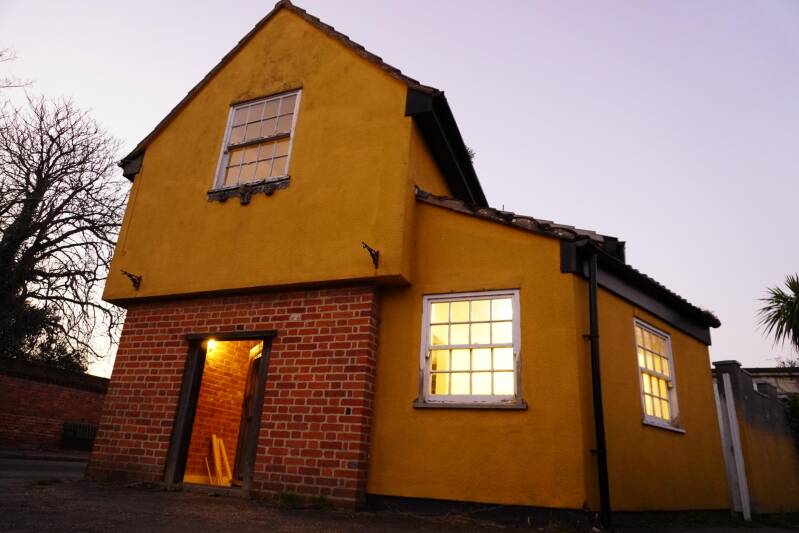
The Cage at St Osyth as it enters a new chapter under its present ownership.
Its owners have also spoken about commemorating those who suffered during the St Osyth trials and preserving the Cage as a place of local historical and cultural interest.
The reopening is bringing fresh attention to the building. It is also likely to introduce a new audience to the familiar story of Ursula Kemp and the haunted lock-up.
Yet this new chapter has begun at exactly the moment when researchers are asking whether that story belongs to the surviving building in quite the way people have assumed.
That need not be treated as an attack upon the Cage or its owners. Historical research does not diminish a place by making its story more complicated. Quite often, the complication is the most interesting part.
Even if the present building never held Ursula Kemp, it remains closely connected with the way her story has been remembered. It has become a focus for discussion of the trials, a well-known location within modern paranormal culture and a building that has inspired strong reactions from owners, investigators, residents and visitors.
Its significance is no longer dependent upon a single claim.
Where history ends
So, what is the Cage?
It may incorporate part of a former village lock-up, as local tradition maintains. It may instead be a nineteenth-century building that inherited the name and history of an earlier structure standing a few feet away. The surviving evidence does not place Ursula Kemp inside either one.
We know that a lock-up existed. We know that Ursula and other local women were interrogated at St Clere’s Hall before being imprisoned at Colchester Castle. We know that the current building was substantially altered, and we know that Vanessa Mitchell’s experiences transformed its reputation during the early twenty-first century.
Between those points lie the uncertainties.
For me, that is where the Cage becomes more interesting, not less. It is not simply the remains of one moment in 1582. It is a place that has been rebuilt physically and remade through storytelling.
The witch, the lock-up and the haunted house did not necessarily begin as one history. Over time, they became almost impossible to separate.
That may be the real story of the Cage.
Not simply whether it is haunted, but how one small building in an Essex village came to hold so many different pasts within its walls.
Sources and further reading
· Marion Gibson, The Witches of St Osyth: Persecution, Betrayal and Murder in Elizabethan England
· W. W., A True and Just Recorde of the Information, Examination and Confession of All the Witches Taken at St Osyth (1582)
· Essex Record Office: Looking for Witches in St Osyth
· Colchester Museums: Wicked Spirits
· St Osyth Museum: The Cage
· Paranormal Reason: The True Location of St Osyth’s Cage
· Paranormal Reason: New Photographic Evidence Refines the Location
· Vanessa Mitchell and Richard Estep, Spirits of the Cage
· The Cage of St Osyth: Official History
· Amy’s Crypt: The Cage, St Osyth’s Infamous “Witch Prison”
Richard Clements
The History Alchemist
Exploring the people, places and stories that sit between recorded history, local memory and folklore. The History Alchemist looks beyond the familiar version of the past, asking what can be established, what remains uncertain and how stories change as they are passed down.
Add comment
Comments