How an Essex newspaper story became a modern legend
I spend quite a bit of time searching old newspapers. Usually I'm looking for something quite specific, but every now and then another story appears that sends me off in a completely different direction.
That happened recently while I was working through newspapers from the summer of 1987.
The headline was impossible to ignore.
"Werewolf Seized in Southend."
I could just about remember hearing the story years ago, although the details had long since faded. My first thought was that it would turn out to be one of those curious newspaper stories that causes a stir for a few days before everyone moves on. It didn't take long to realise there was rather more to it than that.
One newspaper led to another. Before long I was comparing the earliest reports with later books, television programmes and websites. Somewhere during that process I realised I wasn't really researching an alleged werewolf at all.
I was following the birth of a modern legend.
The more I read, the less interested I became in whether there had ever been a werewolf in Southend. What really fascinated me was how quickly the story changed. Somewhere between the first newspaper reports and the versions repeated today, Bill Ramsey slowly disappeared behind a nickname that has proved remarkably difficult to shake off.

The Sun, front page, 24 July 1987.
The Incident
Strip away the dramatic headlines and there is a surprisingly ordinary man at the centre of the story. Bill Ramsey was a Southend carpenter, married to Nina, raising a family and living a life that gave little hint of the attention that would soon follow.
The stories most people know about Ramsey's childhood come from interviews he gave years later. He recalled strange sensations, sudden bursts of anger and an early fascination with wolves. Whether every detail remained exactly as he remembered it after so many years is impossible to know, but those recollections gradually became part of the legend that developed around him.
The public first encountered Bill Ramsey during July 1987.
The contemporary newspaper reports broadly agree about what happened, although there are small differences between them. Ramsey arrived at Southend Police Station accompanied by a young woman whom several newspapers described as a prostitute. Exactly why they had gone there remains unclear. Some reports suggest Ramsey had driven her there himself, while others simply record that she sought help after becoming concerned by his behaviour.
Whatever the circumstances, events quickly escalated.
Whatever had brought Ramsey to the station, the situation suddenly deteriorated. Newspaper reports describe him growling, baring his teeth and holding his hands like claws while officers struggled to bring him under control. It must have been an extraordinary scene for everyone involved.
The disturbance continued.
According to several newspaper reports, Ramsey somehow forced his head and one arm through the small hatch in the heavy cell door. Firefighters were eventually called, but there was little they could do while Ramsey continued struggling. Only after he had been sedated could he be freed and taken to Runwell Psychiatric Hospital near Wickford.
Looking back through those reports today, one thing immediately stands out.
Inspector Tony Belford's comments are among the most revealing parts of the contemporary reports. Rather than suggesting anything supernatural, he repeatedly spoke about a man in obvious distress who genuinely believed he was a werewolf. Several newspapers also referred to the rare psychiatric condition known as clinical lycanthropy. Whether that diagnosis was ever confirmed is impossible to say today, but it does show the direction in which police and journalists were initially looking.
The headlines, however, were beginning to tell a rather different story.

Bill Ramsey, photographed following the Southend Werewolf incident. Image credit: The Sun, 24 July 1987.
When the Story Changed
It might seem like a small distinction, but it changes the story completely. Reporting that someone behaved like a werewolf is one thing. Announcing that a werewolf has been captured is something else altogether, and it wasn't long before that became the version many people remembered.
Within days newspapers across Britain were carrying variations of the same extraordinary story. Most readers never met Bill Ramsey. They remembered the headline instead.
The Southend Werewolf.
Looking back, this seems to have been the moment when Bill Ramsey slowly disappeared behind the nickname. The complicated reality of a man experiencing a deeply disturbing episode became something simpler and much easier to retell.
Looking back, the change wasn't dramatic. It happened gradually. Each retelling seemed to smooth away another rough edge until the nickname became more memorable than the man himself.
Across the Atlantic
At that point the story could easily have faded away. Newspapers are full of unusual incidents that briefly capture public attention before slipping quietly into obscurity. Bill Ramsey's story took a very different path.
The case attracted the attention of American paranormal investigators Ed and Lorraine Warren. Already well known through their involvement in a number of high-profile investigations, the Warrens believed Ramsey's behaviour was not the result of mental illness but of demonic possession. It was a conclusion very different from the one suggested in the earliest newspaper reports.
Their involvement changed everything.
What had begun as a local Essex story was suddenly transformed into an international paranormal case. The British newspaper The People reportedly sponsored Bill and Nina Ramsey's journey to Connecticut, where Bishop Robert McKenna agreed to perform an exorcism.
The contrast with the newspaper reports published two years earlier is striking.
Where the first reports spoke of police officers, hospitals and medical explanations, later accounts centred on Latin prayers, holy water and an apparent struggle between good and evil. Whether readers accepted those claims is almost beside the point. The story had entered a completely different world.
It was no longer simply an unusual incident reported in the British press. It had become part of the growing body of paranormal literature that surrounded the Warrens and their investigations, ensuring that Bill Ramsey's story reached an audience far beyond Essex.
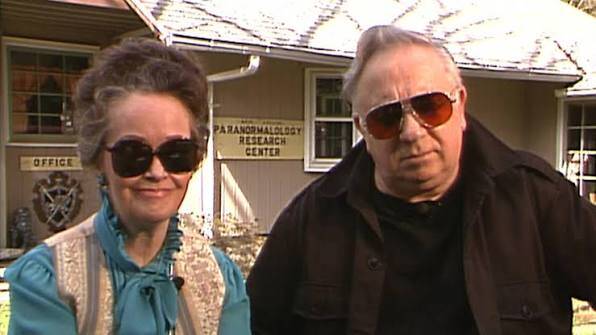
Ed and Lorraine Warren, American paranormal investigators who became involved in the Bill Ramsey case in 1989.
More Than a Werewolf Story
Reading the different versions side by side proved one of the most interesting parts of the research.
The earliest newspaper reports leave plenty of unanswered questions. They disagree on small details and reflect the confusion surrounding a rapidly developing incident. Later accounts are much neater. Ramsey's childhood experiences take on greater importance, the journey to America becomes the obvious climax and many of the uncertainties quietly disappear.
That's hardly surprising.
Stories rarely remain exactly as they were first told. Every retelling smooths away another rough edge until the narrative becomes easier to follow than the events that inspired it.
Looking back, that seems to be exactly what happened here.
Somewhere along the way, Bill Ramsey the carpenter became Bill Ramsey the Southend Werewolf.
When I first came across that newspaper headline, I expected to uncover another curious paranormal story.
Instead, I found something rather more interesting.
The newspapers from 1987 show police officers trying to deal with a deeply disturbing incident involving a man they believed needed medical help.
The Warrens looked at the same events but reached very different conclusions from the police officers who had dealt with Ramsey in Southend. From there the story spread through books, television and, eventually, the internet, each generation discovering it in its own way.
Whether Bill Ramsey suffered from the exceptionally rare condition known as clinical lycanthropy, another psychological disorder or something that still defies explanation is something history is unlikely ever to answer with certainty.
That, however, is no longer the question that interests me most.
What history can show us is how an extraordinary local incident gradually escaped its original setting and developed into one of Britain's best-known examples of modern folklore.
In many ways, that is the real story.
Not the hunt for a werewolf, but the journey of a newspaper headline.
A troubled Essex man became a familiar name in paranormal circles around the world. A police incident became a television documentary. Books, websites and podcasts carried the story to new audiences, each adding another layer along the way.
The Southend Werewolf may never be fully explained.
The making of the legend, however, can still be followed almost step by step.
For me, that is every bit as fascinating.
Sources and References
Contemporary Newspapers
- West Lancashire Evening Gazette – 24 July 1987
- Yorkshire Post and Leeds Intelligencer – 24 July 1987
- Daily Express – 25 July 1987
- Brentwood Gazette – 7 August 1987
- The People – 30 July 1989
Books
- Robert David Chase, Werewolf
Television
- Sightings (1992)
Online Resources
- Mysterious Phenomena – "Meet Bill Ramsey, The Southend Werewolf"
- Residual Whispers – "HalloWarrens Week! – Paranormal Occurrence: The Southend Werewolf"
Richard Clements
The History Alchemist
History Alchemist Investigations
History Alchemist Investigations explores the origins of unusual stories, forgotten incidents and enduring legends. Rather than attempting to prove or disprove extraordinary claims, each investigation returns to the earliest available evidence, tracing how stories develop, change and, in some cases, become part of modern folklore.
Add comment
Comments