A 1980s home computer, a stream of unexplained messages, and the uneasy sense that something had begun to answer back
This series has gradually drifted, almost without meaning to, from objects pulled out of the ground to things that are harder to pin down. The earlier entries had weight to them. Gold, wood, bone. You could point to them, measure them, argue over them in a practical sense. This one sits a little differently. It still belongs in the margins, but the edge it occupies is closer to the present, and less certain.
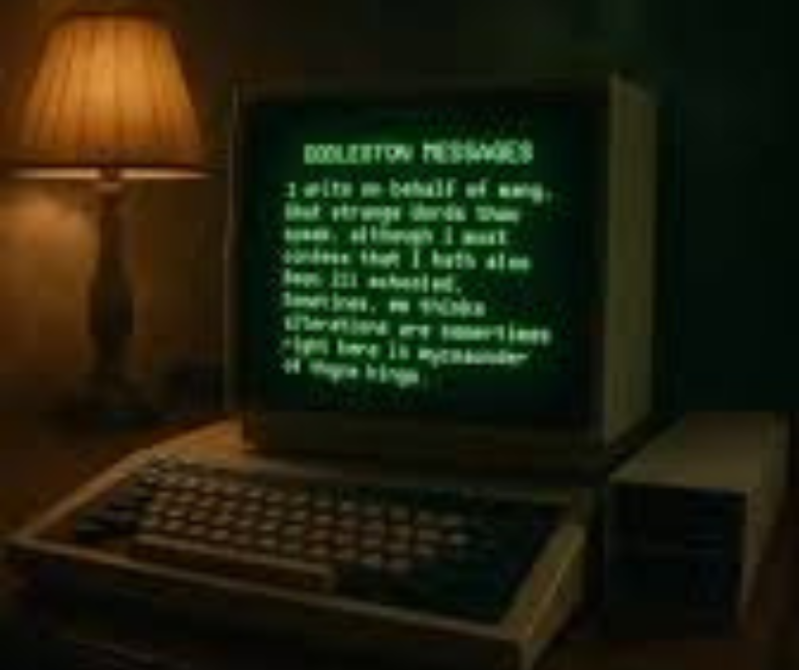
The Vertical Plane is not a find in the usual way. It is a book, published in the early 1980s, written by Ken Webster and centred on a series of events said to have taken place in 1984 at a house in Dodleston, near the Welsh border. The setting matters. Not a lab, not a school, but an ordinary domestic room with a BBC Micro set up on a desk, the sort of arrangement that was just becoming familiar at the time.
According to Webster’s account, messages began to appear on the screen without clear input. At first they were taken for the usual sort of fault. A machine misbehaving, a stray command left in memory. But the text did not behave like that for long. It settled into something more structured, sometimes written in a rough, almost phonetic English, attributed to a figure calling himself Lukas, who claimed to be writing from the sixteenth century. Later, other voices seemed to intrude, less consistent, harder to follow.
The correspondence, if that is the right word for it, unfolded over time. Friends and colleagues were drawn in. Printouts were kept. Attempts were made to test what was happening, though the line between testing and participation seems to blur as you read through it. Some of it feels deliberate, almost staged in hindsight. Some of it does not.
It is not difficult to see why the story settled where it did. Early home computers carried a kind of quiet authority while remaining largely opaque to the people using them. You could type a command and receive an answer without fully understanding how the exchange had taken place. That small gap, the unseen process between input and output, left room for interpretation. In most cases it was filled with learning, trial and error, the slow grasp of a new tool. In a few cases, perhaps, it was filled with something else.
The book itself does not resolve the matter. It presents the material, reflects on it, and leaves it there. Sceptical readings point to hoax, misdirection, or simple experimentation that slipped out of control. Others have been more willing to entertain the idea that something unusual took place, though rarely with any firm conclusion.
What remains is not the claim, but the setting. A house, a desk, a machine that had only just begun to enter everyday life. And on its screen, for a time, words that seemed to arrive from somewhere just beyond the usual reach of explanation.
Richard Clements
The History Alchemist


Add comment
Comments