A quiet Sunday field trip into one of Britain’s most unusual Roman landscapes, where three surviving mounds hint at a much larger and long-forgotten story
This visit to Bartlow Hills came as a Sunday field trip, one I made with my friend Darryl. We have fallen into the habit of these outings over time, quietly exploring places that sit somewhere between history and suggestion. Darryl has helped me more than once behind the scenes, often reading through my work and offering a steady second pair of eyes, and we tend to share the same curiosity when it comes to landscapes like this. It felt fitting, then, that we approached this site together.
We arrived at Bartlow without quite knowing where to begin. There is no grand car park waiting for you, no obvious point of entry. We ended up pulling in beside the village church, which felt as good a place as any to start.
As it turned out, that small uncertainty worked in our favour. There was a couple walking around the churchyard, and on asking them if they knew where the burial mounds were, they pointed us in the right direction without hesitation. Just follow the footpath running off beside the church, they said. You cannot miss them.
They were right.
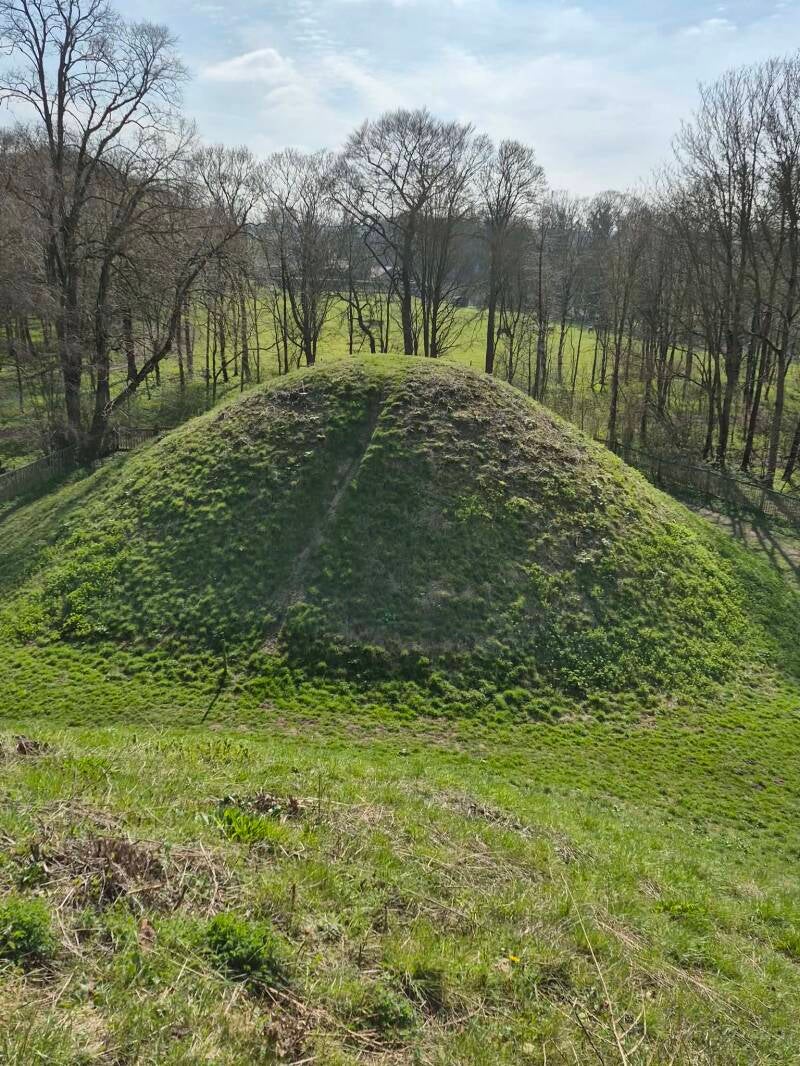
The path leads you gently away, and then, almost without warning, the ground begins to rise in shapes that feel just slightly out of place. What remains of the site reveals itself gradually. Three mounds now, set close together. One large central mound, flanked by two smaller ones.
All three are striking.
First Impressions in the Landscape
What stood out to both of us immediately was how deliberate they look. These are not softened, irregular earthworks. They are clean, almost geometric in their form. Conical. Balanced. Even after nearly two thousand years, they hold their shape in a way that feels almost unnatural.
They do not look ancient in the way you expect.
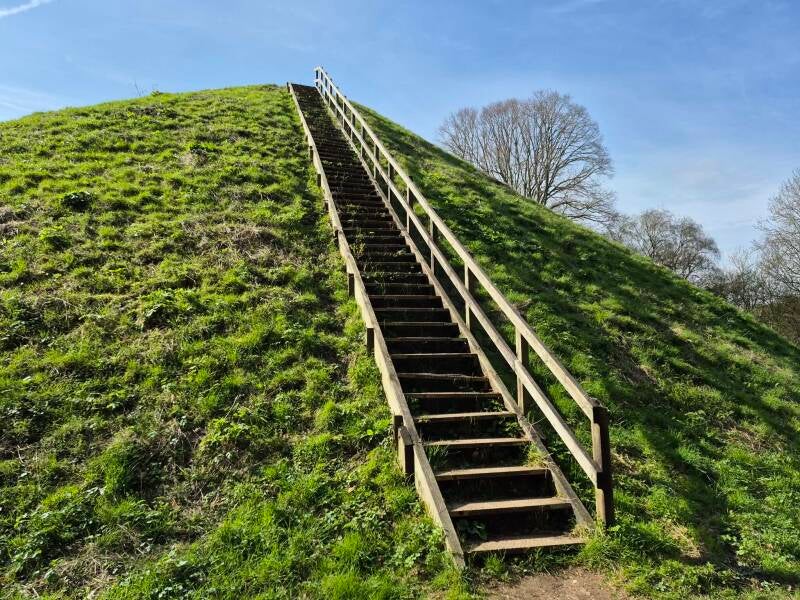
The central mound draws you in. A wooden staircase has been set into one side, allowing access to the top. Climbing it gave us a clear view across the site, which is smaller than you might imagine. The three surviving mounds sit within a defined area, close enough to feel like a single composition rather than a scattered group.
From above, the arrangement becomes clearer. Intentional. Planned.
There is also an information board nearby, outlining the history and marking where the other mounds once stood. Because there were more.
Several more.
A Roman Statement in Earth
Bartlow Hills, often referred to as the “Essex Pyramids,” are the largest Roman burial mounds in Britain. Though today only three are prominent, there were originally at least seven, possibly more.
They date to the Roman period, most likely between the late 1st and early 2nd century AD, when this part of Britain was firmly under Roman control.
Excavations in the 19th century uncovered cremation burials at the heart of these mounds. Within wooden chambers, the remains of the dead had been placed in urns, accompanied by grave goods that spoke of wealth and status.
Glass vessels of remarkable quality. Bronze items. Fine objects that had travelled from across the Roman world.
These were not ordinary burials.
They suggest individuals of considerable standing, perhaps a local elite family who had adopted Roman customs, or figures connected to administration or trade along nearby routes. The exact identities are unknown, but the scale alone tells its own story.
This was a place designed to be seen.
What Has Been Lost
Standing on the central mound, looking out across the remaining three, it is difficult not to think about what is missing.
The information board marks the positions of the others. Mounds that once stood alongside these, completing a much larger and more imposing complex. Over time, they have been reduced, levelled, or simply absorbed back into the landscape.
What remains is only a fragment.
Yet even as a fragment, it carries weight.
The surviving mounds still rise cleanly from the ground, their form largely intact. There is very little sense of decay in their shape. They hold themselves in a way that feels intentional, as though the passage of time has altered the surface but not the design.
The Quiet Presence of the Site
After the initial sense of discovery, the site settles into something quieter.
There is no barrier to walking here, no sense of distance between you and the past. We were able to move freely between the mounds, climb the central rise, and look out across the surrounding fields, trying to picture how this might once have appeared. Freshly built. Larger. More numerous. Visible from far beyond the immediate area.
Now, it sits in near stillness.
It is not a dramatic place, and perhaps that is what makes it linger. There is no single story being told, no definitive explanation waiting on the signboard. Just fragments of history, carefully uncovered, and then left to rest again.
Closing Notes
We spent a good hour here without really noticing the time passing. Moving between the mounds, returning to the same viewpoints, taking photographs, and quietly taking in the place for what it is.
It is a small site, but not a slight one.
Bartlow Hills does not overwhelm. It does something quieter than that. It holds its ground. It lets you come to it, rather than the other way around.
And perhaps that is why it stays with you.
Not because it demands attention.
But because it does not.
Richard Clements - The History Alcamist



Add comment
Comments