St Peter-on-the-Wall and the Liminal Landscape
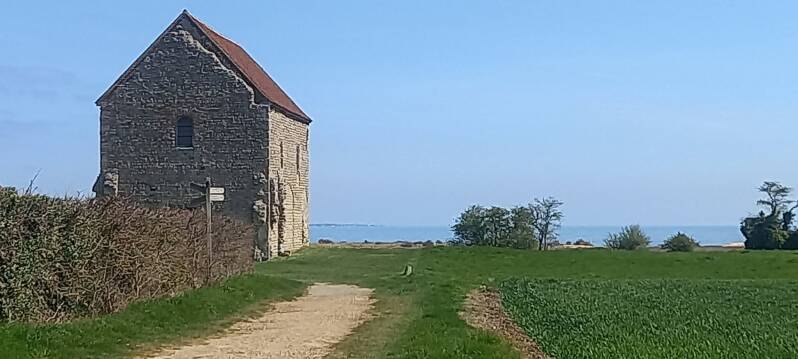
St Peter-on-the-Wall comes into view at the end of the long approach, its ancient walls standing against the open landscape of the Essex coast.
There are some places you discover, and others that seem to have been waiting quietly in the background for most of your life.
St Peter-on-the-Wall belongs to the second category for me.
I first knew Bradwell and the chapel as a child during the 1970s. Back then, the Sunday afternoon family drive was still something of a tradition in our house. My dad would be behind the wheel and we would head off somewhere for the afternoon, often without the sort of planning that seems to accompany almost every journey today.
St Peter-on-the-Wall seemed to be one of our regular destinations.
I cannot pretend that the history of an Anglo-Saxon chapel occupied my thoughts very much as a young boy. What stayed with me was the place itself. The walk out towards the chapel, the small building standing almost alone and the great expanse of sky and water beyond it.
For many years afterwards, St Peter's remained somewhere in the background of my memory.
More recently, I began going back. I have taken friends there, walked the familiar route again and gradually realised that St Peter's has become something more than an old building I happen to know.
It has become one of the places that best explains what I mean by The History Alchemist.
I am increasingly interested in the edges of history. Places where the landscape matters as much as the surviving building, where several different pasts overlap and where certainty begins to give way to something less easily defined.
St Peter-on-the-Wall stands almost literally at such an edge.
The walk to St Peter's
You cannot simply pull up outside St Peter-on-the-Wall.
You leave the car behind and there is a good walk ahead of you before the chapel is reached.
I think that matters.
With every visit, there comes a point when the car park and the modern world begin to fall away behind me. The landscape opens. The sky seems larger. Ahead, the chapel gradually becomes the focus.
It is a remarkably simple building.
There is no great tower announcing its presence across the Essex countryside. No collection of medieval buildings surrounds it. There is no village street leading to its door.
It stands there almost by itself.
Visitors repeatedly describe St Peter's using similar words: peaceful, isolated, spiritual, tranquil. Some arrive because they are interested in early Christianity. Others come because they are walking the coast or St Peter's Way. Some probably know very little about the building before they arrive.
Yet many appear to respond to the setting as strongly as they do to the chapel.
That is certainly true for me.
And perhaps the walk is part of it. By the time you reach St Peter's, you have already made a small transition. You have left one landscape and entered another.

The long approach to St Peter-on-the-Wall, Bradwell-on-Sea. At first, the ancient chapel is nowhere in sight, with only the track stretching ahead across the open Essex countryside.
A Roman fort that has disappeared
Long before St Peter's stood here, this was the site of the Roman fort of Othona.
Othona was established during the later Roman period and formed part of the network of coastal defences traditionally known as the Saxon Shore forts. Its position close to the mouth of the Blackwater made strategic sense. From here, movement through the estuary and along the coast could be observed and controlled.
But don't come to Bradwell expecting another Burgh Castle.
I have walked around St Peter's many times and have never been able to look across the landscape and say, there is the Roman fort.
For the ordinary visitor, Othona has gone.
Archaeology can detect what remains beneath the ground, but there are no great walls standing across the fields to help us reconstruct the fortress in our imagination. Even knowing it was there, I find it difficult to picture.
Instead, some of the most tangible evidence for Roman Othona is contained within the building that replaced it.
Look carefully at St Peter's and Roman material was reused in its construction.
One age has quite literally been built into another.
Cedd comes to the edge
The story of St Peter's traditionally begins around AD 654 with Cedd, a missionary associated with the conversion of the East Saxons.
The principal early source is Bede, who records Cedd establishing a church at a place called Ythancæstir, generally identified with the former Roman fort at Bradwell.
There are archaeological questions concerning the precise dating of parts of the surviving building, and we should be wary of pretending that every stone can confidently be connected with Cedd himself.
But the wider association is ancient.
What particularly interests me is the choice of place.
Today Bradwell can feel extraordinarily remote. Yet we should not automatically assume that Cedd saw it that way. We live in a world dominated by roads. In earlier periods, rivers and estuaries could connect communities rather than divide them.
The Blackwater was not necessarily the end of the road.
It could be the road.
People, goods and ideas travelled by water. A site that appears peripheral when approached by car may have occupied a very different position when approached by boat.
Even so, there is something remarkable about the transformation.
A place established partly for Roman military power became a place of Christian worship.
And the stones remained.
The building that refused to disappear
St Peter's has not travelled untouched through nearly fourteen centuries.
The building once formed part of a larger religious complex. Parts disappeared. Its use changed. Eventually the ancient chapel became an agricultural building.
A barn.
There is something wonderfully ordinary about that.
People sometimes imagine historic monuments patiently waiting through the centuries to be rediscovered and appreciated by us. Real buildings generally have messier lives.
They are altered, abandoned, repaired, reused and sometimes misunderstood.
St Peter's survived partly because people found another use for it.
Eventually its importance was recognised again and the building returned to religious use.
That means the chapel standing on the Dengie coast today is not simply a seventh-century relic preserved beneath glass.
It has lived.
Roman material became Christian fabric. A Christian building became part of an agricultural landscape. A barn became a chapel again.
Its meaning has changed repeatedly while something physical has remained.

Inside St Peter-on-the-Wall, where simple furnishings, ancient stonework and an exposed timber roof give the small chapel a quiet, timeless atmosphere.
A community amongst the trees
There is another part of the story that can easily be missed.
Close to St Peter's, partly tucked away amongst the trees, stands the Othona Community.
It was established in 1946 by Norman Motley, an Anglican priest who had served as an RAF chaplain during the Second World War. In the aftermath of a conflict that had torn Europe apart, Othona developed around ideas of reconciliation, community and Christian fellowship.
I find its presence fascinating.
More than a thousand years after Cedd, another religious community was deliberately established beside this ancient chapel on the edge of Essex.
I don't think we need to attach anything supernatural to that.
The more interesting question is much simpler.
Why here?
What repeatedly draws people towards this particular patch of coastline?
The Othona Community continues today, discreetly occupying its place beside the older sacred landscape. It is easy to walk towards St Peter's without immediately appreciating that a living community exists nearby.
The old chapel therefore isn't quite as alone as it first appears.
Its religious story did not finish centuries ago.
The lonely coast
Of course, isolation has other uses.
The Essex coast has a long association with smuggling. Creeks, marshes, estuaries and relatively isolated landing places could offer opportunities to anyone hoping to move contraband without attracting the attention of customs officers.
The Dengie Peninsula possessed exactly the sort of geography that could make coastal surveillance difficult.
Stories inevitably accumulated around such places.
There is a widespread tradition around Britain's smuggling coasts that tales of ghosts and supernatural creatures could discourage respectable people from wandering into places where they were not wanted after dark. It is an attractive idea and sometimes repeated as though every lonely coastal ghost was secretly working for the smugglers.
I would be more cautious.
I have yet to find convincing evidence that smugglers around St Peter-on-the-Wall deliberately invented ghost stories about the chapel to keep people away.
That doesn't mean nobody ever did. It simply means that a good story should not be promoted into history without evidence.
Nor have I found a convincing local tradition placing East Anglia's famous spectral Black Shuck at St Peter's.
Perhaps that is appropriate.
St Peter's doesn't need us to provide it with a ghost.
The landscape can look after itself.
Beyond the chapel
Most histories of St Peter-on-the-Wall understandably stop at the chapel.
I prefer to keep walking.
Go beyond St Peter's and eventually the land meets the Blackwater.
This, for me, is where the character of the place becomes clearest.
Behind you stands one of the oldest surviving Christian buildings in England, constructed partly from the material of a Roman world that has otherwise disappeared from sight.
Nearby is a modern religious community.
Around you are marsh, grassland and enormous Essex skies.
Ahead is water.
Across it, another shore remains visible in the distance. It is close enough to remind you that the world continues, yet sufficiently removed to appear somehow separate from where you are standing.
And eventually there comes a simple fact.
You cannot keep walking forwards.
The land has run out.
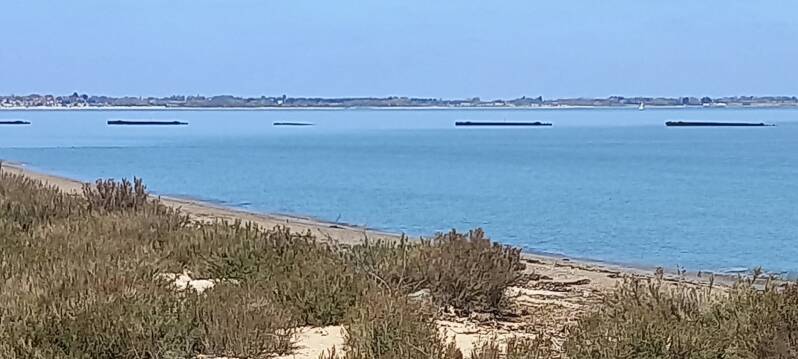
Beyond St Peter-on-the-Wall, the shoreline opens onto the Blackwater Estuary, with Mersea Island visible across the water. A landscape where land and sea meet, and the sense of isolation becomes part of the experience.
A landscape that refuses to stay still
Even that boundary is deceptive.
The coastline around Bradwell has changed repeatedly.
Water, erosion, reclamation and human intervention have altered the relationship between land and sea. Marshland has been drained and enclosed. Sea walls have imposed harder boundaries upon a landscape that naturally resists them.
The shoreline is not really a line at all.
It moves.
That becomes particularly apparent around marshes and tidal water. There are places that are dry at one hour and submerged at another. Mud is neither quite land nor water. Saltmarsh occupies territory claimed by both.
The Romans experienced a different coastline here.
Cedd knew another.
We are looking at another still.
Perhaps somebody standing here centuries from now will see something different again.
The threshold
There is a word that I have increasingly found useful when thinking about places such as Bradwell.
Liminal.
A threshold.
Somewhere between one state and another.
It is a term that can become unnecessarily complicated when buried beneath academic language, but the basic idea is wonderfully simple.
A doorway is liminal because it is neither completely inside nor completely outside.
A shoreline can be liminal because it is where land becomes water.
Dusk is liminal because it is neither properly day nor completely night.
And history itself can sometimes feel liminal when evidence begins to thin and memory, tradition and folklore start occupying the gaps.
St Peter-on-the-Wall seems surrounded by thresholds.
Roman and Saxon.
Pagan world and Christian world.
Military site and sacred site.
Church and barn.
Past and present.
Land and water.
And perhaps most obviously of all, the enormous meeting of earth, sea and sky.
Scholars studying St Peter's have themselves used ideas of liminality when considering this landscape. What interests me is that you don't need to know the word before you experience it.
I certainly didn't when I first came here as a child.
After dark
And then there is darkness.
St Peter's changes when you imagine the landscape without daylight.
That does not require a ghost.
Remove the broad daylight and familiar reference points begin to disappear. The distant shore becomes harder to distinguish. The water becomes darkness rather than scenery. Sounds carry differently. A building that appears peaceful beneath a blue sky can acquire an entirely different presence as evening closes around it.
Perhaps our ancestors were more accustomed to such darkness than we are.
We flood our settlements with artificial light. Roads, houses, shops, phones and street lamps continually reassure us of where we are.
Places such as St Peter's can still strip some of that away.
It is easy to understand why lonely coasts acquired stories.
It is easy to understand why smugglers might have valued darkness.
It is easy to understand why generations of people have found spiritual meaning in isolation.
And it is equally easy to understand why the same landscape might make another visitor uneasy.
The place hasn't necessarily changed.
We have.
Where the land runs out
I have been returning to St Peter-on-the-Wall for much of my life.
As a child, I wouldn't have called it a liminal landscape. I doubt I could even have explained why the place remained with me.
Now I think I understand it a little better.
My work as the History Alchemist increasingly takes me towards edges. Not because I believe every strange place must be haunted, or because folklore should be accepted as history, but because edges are often where different versions of the past meet.
St Peter's is almost a physical expression of that idea.
The Roman fort has disappeared from sight, yet parts of it survive within the chapel. Cedd's religious world has gone, yet people still worship here. The building became a barn, yet became sacred again. Another community arrived in the twentieth century and found meaning in the same landscape.
And beyond all of them remains the Blackwater.
Perhaps that is why I keep coming back.
You can walk out towards St Peter's carrying nearly two thousand years of history with you.
You can enter the chapel.
You can touch walls containing stones from a vanished Roman fort.
And then you can walk beyond it until eventually history, footpath and solid ground seem to reach the same conclusion.
There is nowhere else to go.
Only water, another shore and the horizon.
And sometimes the most interesting places in history are found precisely there.
At the edge.
Further Reading
Johanna Dale (ed.), St Peter-On-The-Wall: Landscape and Heritage on the Essex Coast, UCL Press, 2023. A particularly useful study of the chapel within its wider archaeological, coastal and spiritual landscape.
UCL Press: St Peter-On-The-Wall
Historic England: Chapel of St Peter-on-the-Wall
St Peter-on-the-Wall: official chapel website
The Othona Community, Bradwell-on-Sea
Bede, Ecclesiastical History of the English People, particularly the passages concerning Cedd and the conversion of the East Saxons.
Richard Clements
The History Alchemist
Exploring the people, places and stories that sit between recorded history, local memory and folklore. The History Alchemist looks beyond the familiar version of the past, asking what can be established, what remains uncertain and how stories change as they are passed down.
Add comment
Comments